


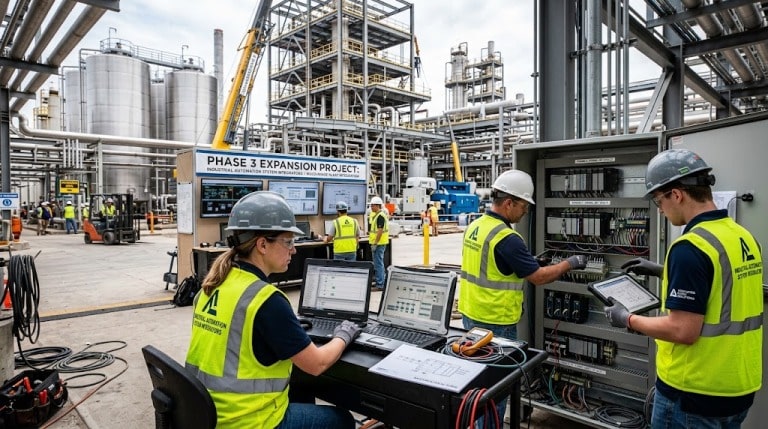
Plant expansions seldom happen in one clean step, especially when production must continue while new equipment, utilities, and control hardware come online. Phased projects require automation work that fits the current operation without blocking what comes next. Experienced industrial automation system integrators plan each stage around future capacity, shared infrastructure, and the practical limits of an active facility.
Expansion Planning Starts With the Final Plant Layout in Mind
Early control design should account for the finished facility even if only the first phase has funding or equipment available. Engineers review future production areas, electrical loads, PLC capacity, network architecture, I/O requirements, panel space, and communication paths before deciding what belongs in the initial installation. Thoughtful planning may leave spare network ports, reserved PLC memory, open panel space, or unused conduit routes that later phases can use without major demolition. Strong control integrators also identify temporary connections that must disappear once permanent systems take over, preventing short-term fixes from quietly becoming permanent weaknesses.
How Can New Controls Be Added Without Disrupting Existing Production?
Active plants create a different challenge from greenfield construction because shutdown windows may be short and production schedules cannot simply stop for weeks. Project teams often build and test new panels, PLC programs, and network segments away from operating equipment before making final field connections. Careful staging allows industrial control systems companies to complete more work before a scheduled outage begins, reducing the number of tasks that depend on machines being offline.
Cutover plans then define exactly how controls move from the old arrangement to the new one. Technicians may transfer I/O in groups, migrate one machine at a time, or operate temporary interfaces between older and newer platforms during the transition. Detailed rollback procedures also matter because a failed startup should not leave production crews guessing how to restore the previous system. Clear sequencing gives maintenance staff, electricians, programmers, and operations personnel the same understanding of what changes during each outage.
Scalable PLC and I/O Design Prevents Early Capacity Limits
PLC architecture should leave room for equipment that has not arrived yet. Designers can reserve logical program sections, communication addresses, rack positions, and tag structures so later additions follow the same organization instead of being attached wherever space remains. An integrator in control system expansion work may also select distributed I/O where future production areas sit far from the original control room. That approach can reduce long cable runs while giving each phase a defined place within the larger automation structure.
Why Network Architecture Matters More With Each Added Phase
Industrial networks tend to become harder to manage as new equipment introduces additional switches, drives, HMIs, remote I/O, cameras, and controllers. Network planning separates traffic where appropriate while still allowing the data exchanges needed for production, diagnostics, and supervision. Managed switches, VLANs, fiber links, and redundant paths may become useful as the facility grows across larger distances or adds processes with different uptime needs.
Capacity checks should also consider bandwidth, switch-port availability, addressing, and communication recovery after a failure. Poorly planned expansions can create long switch chains, duplicate IP addresses, overloaded network segments, or undocumented connections that complicate troubleshooting. Organized integrated control systems keep network growth intentional by defining how each new area connects before installation crews begin pulling cable.
Standardized Programming Keeps Separate Project Phases Consistent
Multiple phases may involve different contractors, programmers, equipment vendors, or installation dates, so consistent programming standards protect long-term maintainability. Shared naming rules, alarm formats, motor routines, device structures, HMI conventions, and fault-handling methods make new equipment feel like part of the same plant rather than a collection of unrelated projects. Established industrial automation system integrators can create reusable templates early, giving later phases a tested structure to follow. Standardization also reduces training time because technicians do not have to learn a different control philosophy for each production area.
Testing Each Phase Protects the Systems Already Running
Commissioning should prove both the new equipment and its interaction with existing operations. Teams verify field I/O, sequences, alarms, networks, safety functions, interlocks, and data exchange before releasing a new section for production. Controlled testing can reveal whether a new conveyor blocks an existing line, whether shared utilities respond correctly, or whether added network traffic affects older equipment.
Phased acceptance records become especially useful because each completed stage changes the baseline for the next one. Updated drawings, PLC backups, network maps, device settings, and punch lists show future teams exactly what is installed rather than what an early design originally expected. Accurate records also prevent later contractors from removing spare capacity or reserved infrastructure because they do not understand why it exists.
Long-Term Integration Keeps Separate Expansions Working as One Plant
Finished expansion phases should operate as parts of one coordinated facility instead of isolated automation islands. Shared alarms, production data, HMI standards, controller communications, and system documentation make it easier for operators to understand the plant as it grows. RL Consulting provides electrical controls and integrated control systems support that can help facilities plan phased automation upgrades, coordinate PLC and network expansion, integrate new equipment with existing processes, and preserve a consistent control architecture from one construction stage to the next.
